Workforce Engagement Management
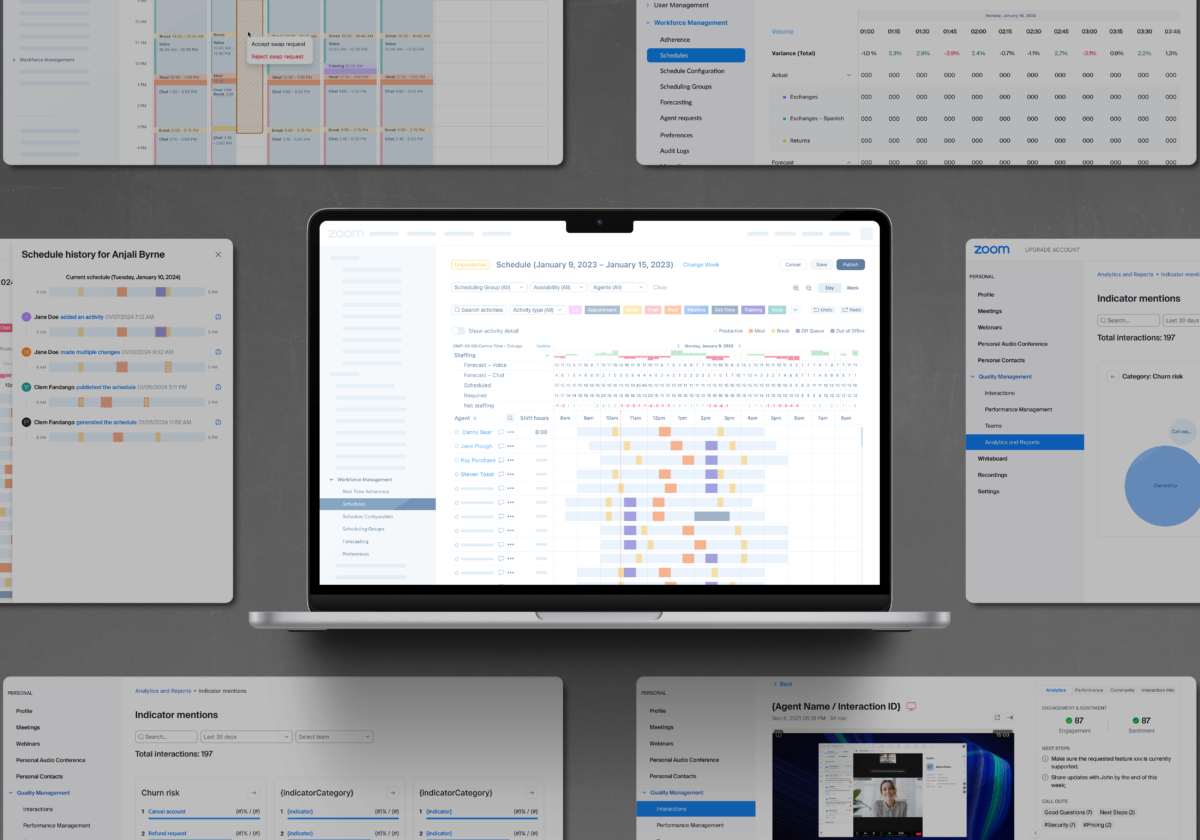
After the recent addition of AI-powered chatbots with Zoom Virtual Agent, Zoom added to the Contact Center suite with two new companions – Workforce Engagement and Quality Management.
These two products offered workforce management and performance management.
ROLE
Lead Product Designer
PRODUCTS
Workforce Management, Quality Management
DURATION
7 months
TEAM
5 Designers, 2 Product Managers,
30 Engineers
PROJECT OVERVIEW
To expand our Contact Center suite, our team set out to design and launch two new products from the ground up: Workforce Management (WFM) and Quality Management (QM). These tools are essential for contact center supervisors to manage staffing, performance, and coaching.
DESIGN CHALLENGES
- Building for Two Distinct User Types Simultaneously
- Designing in Parallel With Scope Changes
- Balancing Vision With Execution
GOALS
- Establish new product verticals within our contact center suite.
- Deliver a compelling UX vision backed by user insight.
- Move from concept to launch in a compressed timeline.
- Shift internal development culture toward agile methods (scrum).
As part of our Contact Center suite expansion, we launched of two net-new products: Workforce Management (WFM) and Quality Management (QM). The initiative began with an internal NPI (New Product Initiative) proposal to gain executive buy-in and validate the strategic value of adding these two products.
Strategic Framing: New Product Initiative
I led the creation of a New Product Initiative (NPI) to support our expansion into the Workforce Management (WFM) and Quality Management (QM) market. Partnering closely with the leadership team, I combined market research and user insights to build a strong business case that showed clear demand and strategic alignment.
The proposal outlined key Jobs-To-Be-Done across contact center operations, backed by customer interviews and primary research. I highlighted how WFM and QM would strengthen our existing product suite, presented competitor analysis, revenue projections, and outlined the resources needed.
This strategic work earned executive support, secured funding and engineering resources, and aligned the company around the opportunity. It was a critical step in closing product gaps and expanding our presence in the contact center space.
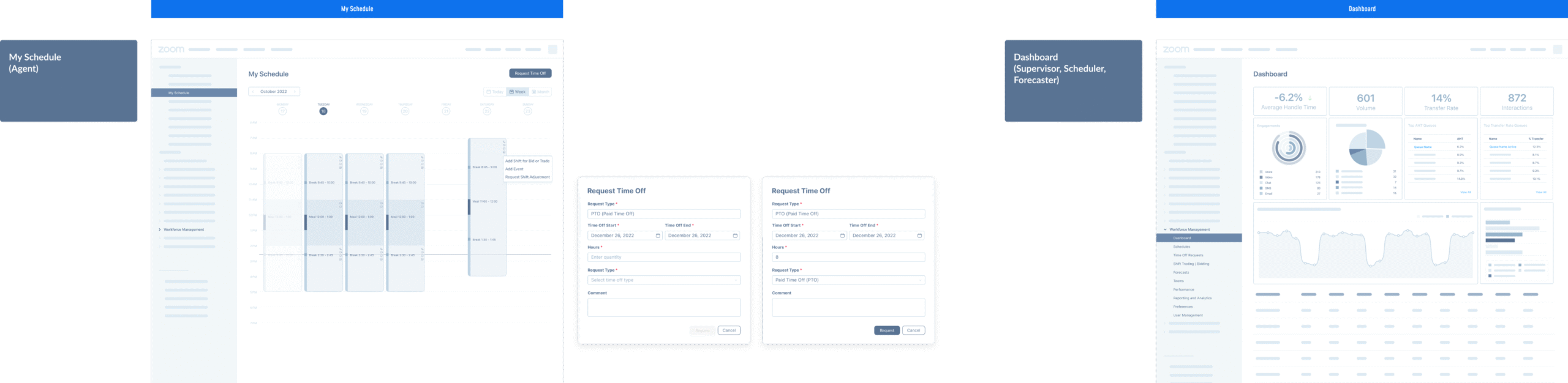
Example of concepts from the NPI:
USER DISCOVERY
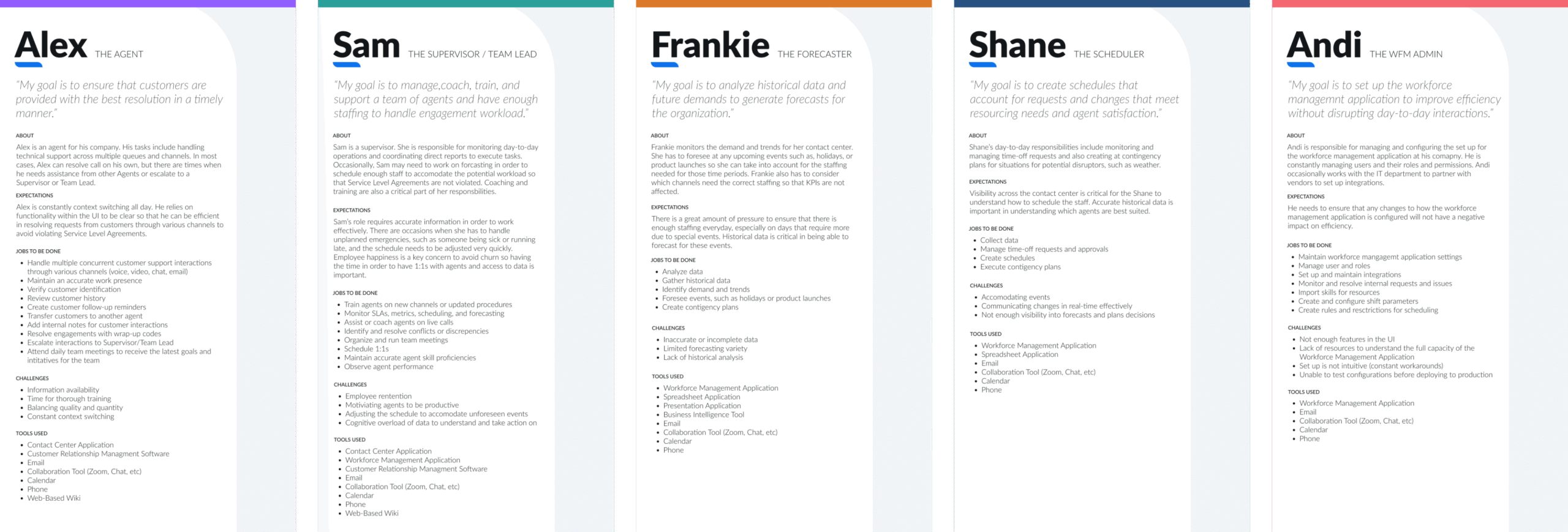
I spearheaded the research phase by conducting in-depth interviews with contact center teams, supervisors, and internal agents who were actively using competitor products. This comprehensive discovery process enabled me to map Jobs-To-Be-Done across critical workflows including scheduling, forecasting, coaching, and quality assurance. From these insights, I developed detailed personas that provided the entire team with clear alignment on our target users and their specific needs.
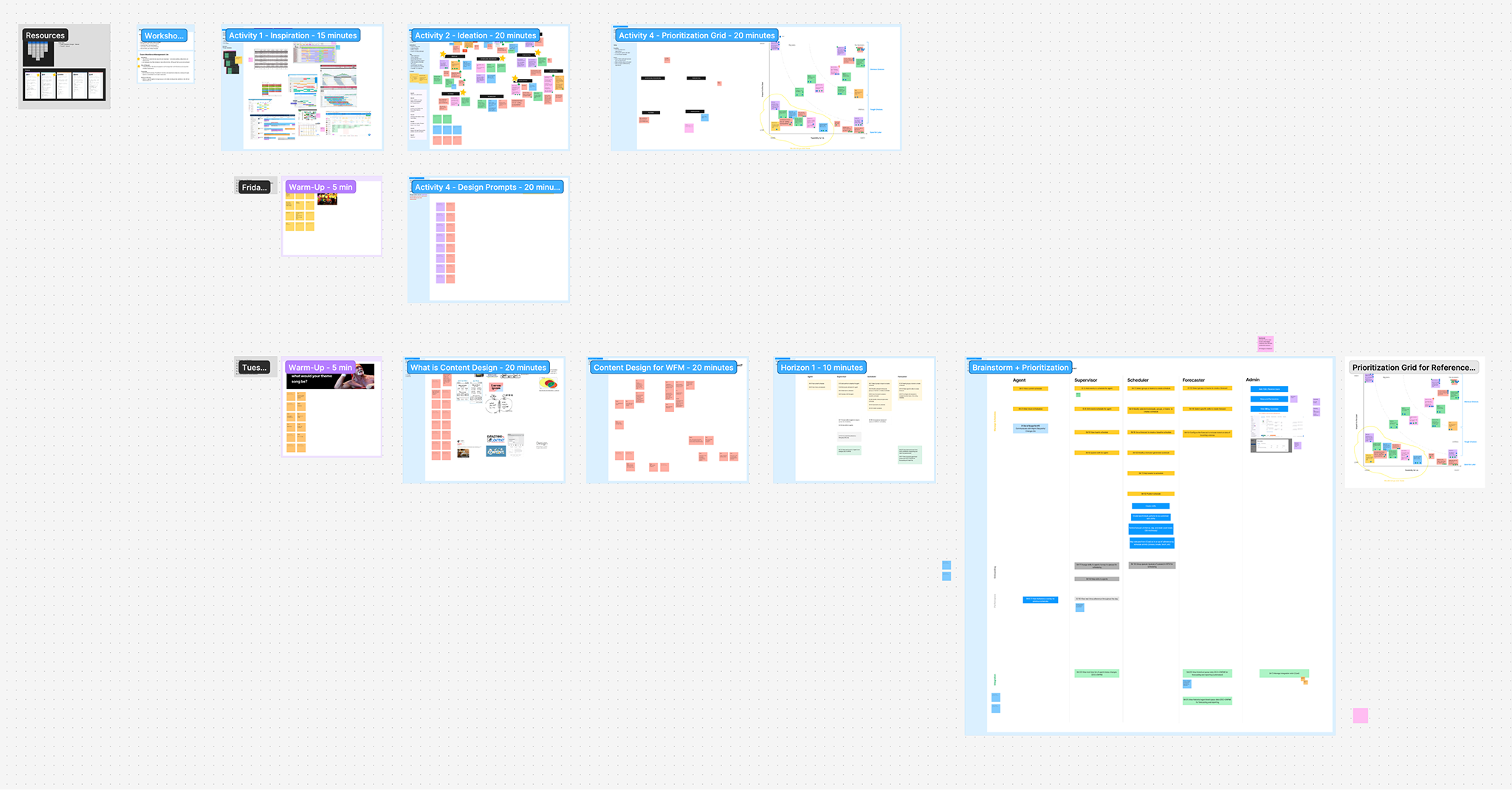
EXPERIENCE VISIONS AND WORKSHOPS
Through facilitated cross-functional workshops, I led collaborative sessions to co-create solution hypotheses and establish measurable success metrics. These workshops produced an Experience Roadmap that strategically aligned customer pain points with business priorities. The research revealed significant opportunities to simplify existing workforce engagement management (WEM) solutions, positioning us advantageously as a new player in the contact center space.
WORKFLOW VALIDATION
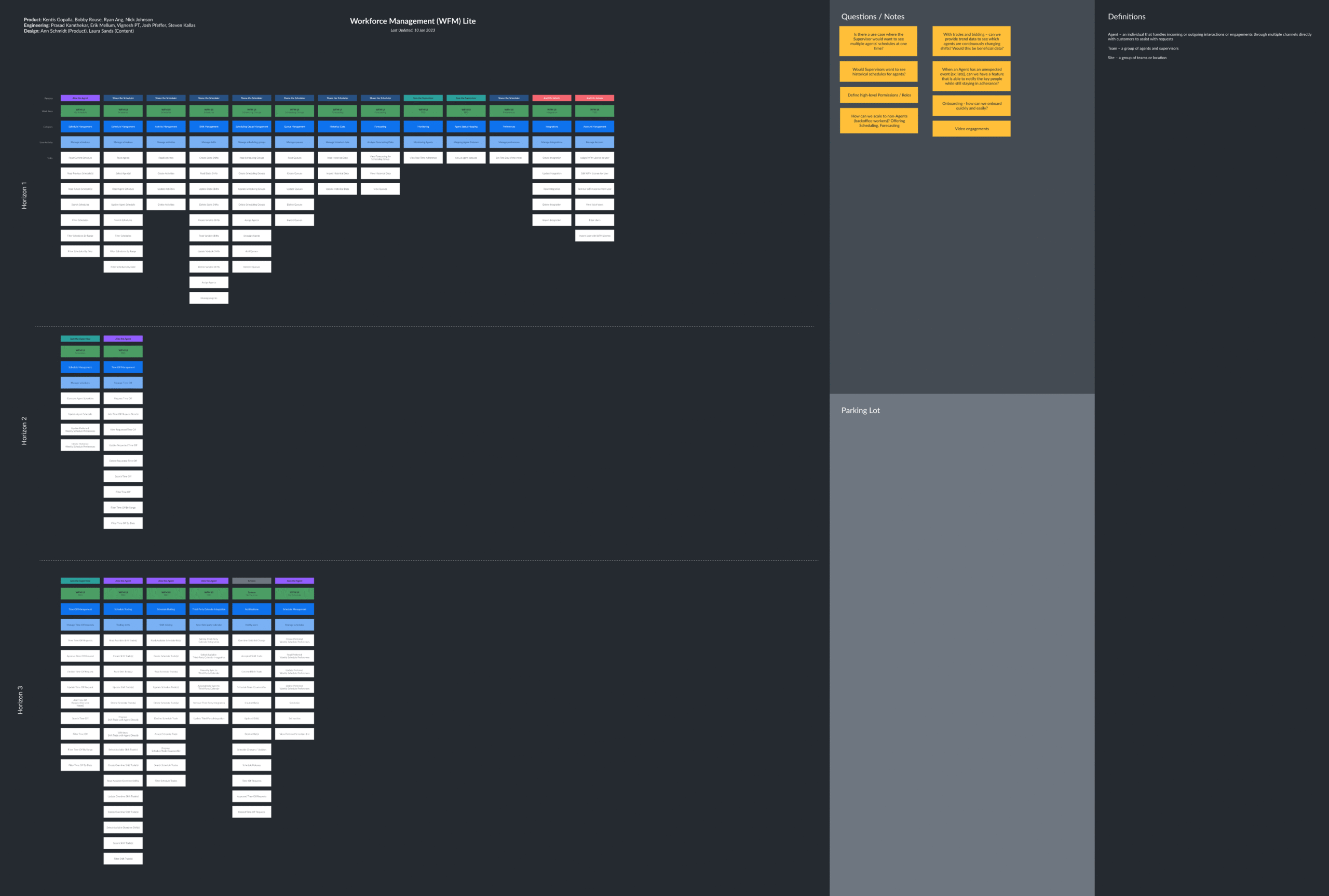
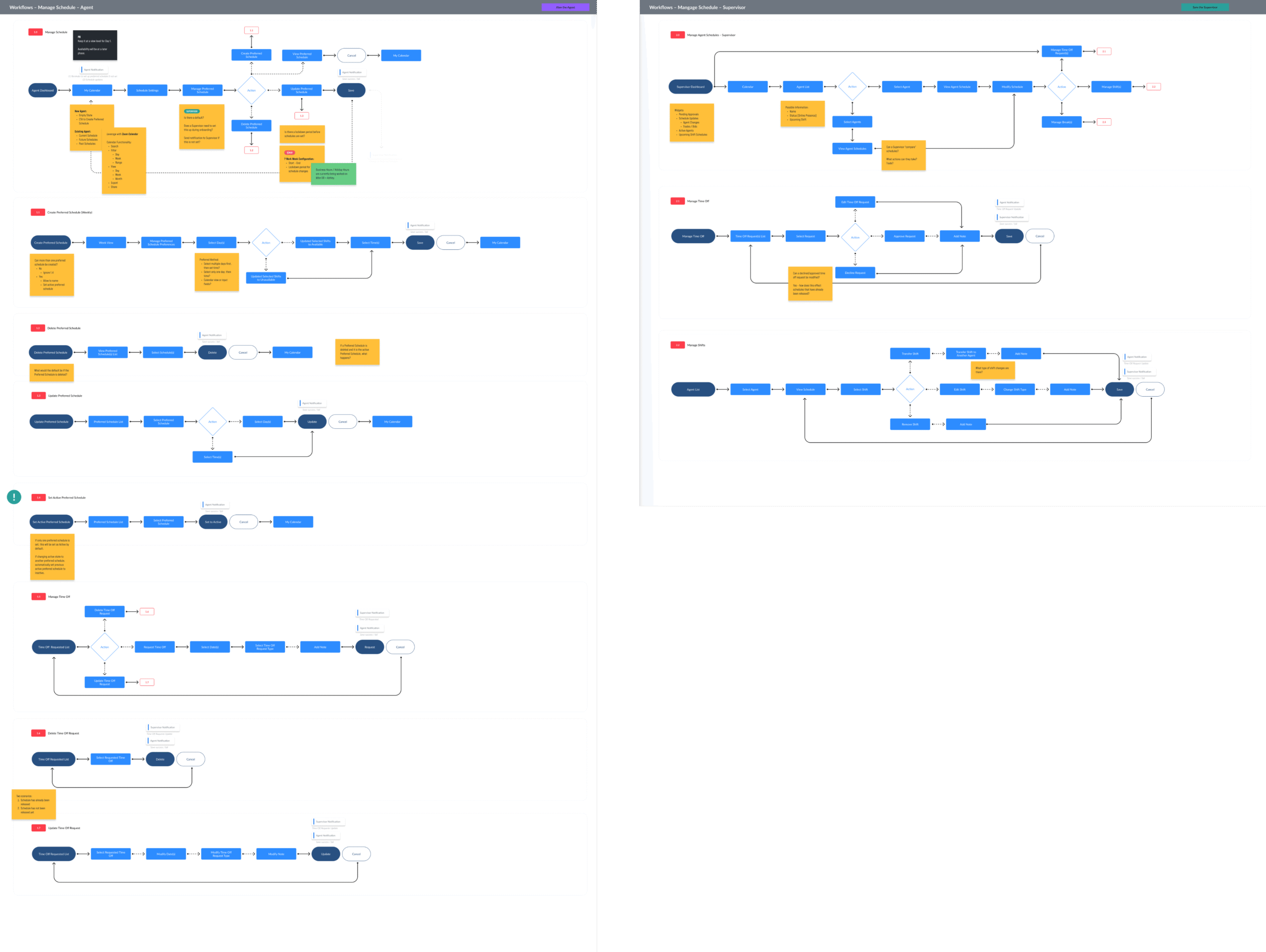
Validating user workflows before entering the design phase proved critical to our project’s success. Through detailed workflow mapping sessions with contact center teams, I discovered significant gaps between how users were supposed to work versus their actual daily practices, revealing workarounds, external tool dependencies, and friction points that weren’t apparent from initial requirements. This upfront validation allowed me to design solutions based on real user behavior rather than stakeholder assumptions, ultimately accelerating our timeline by eliminating multiple design iterations and ensuring our final product aligned with genuine user mental models from the start.
RAPID CONCEPTING + ITERATION
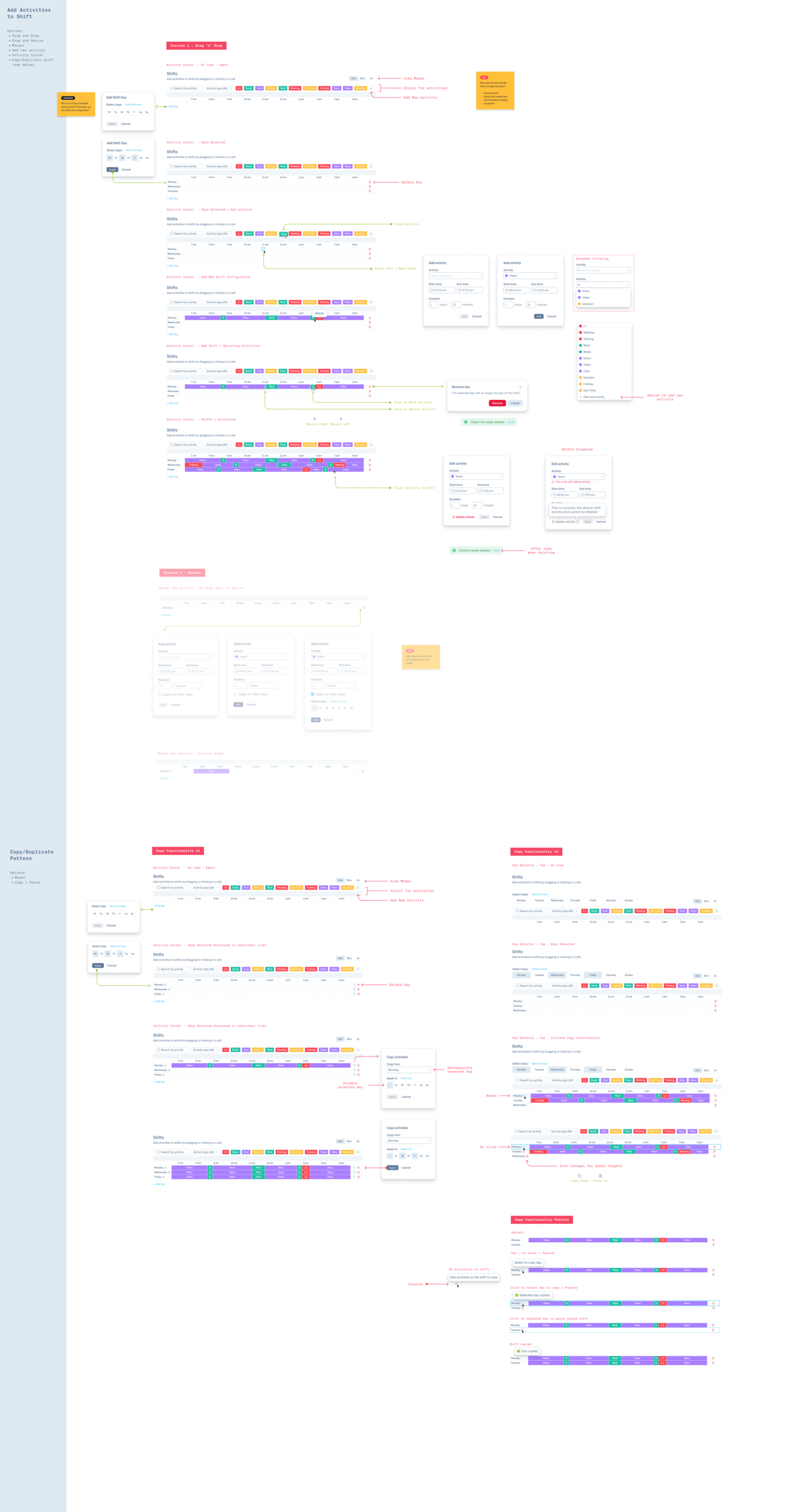
I mapped out initial wireframes that mapped core user workflows while clearly articulating the product’s unique value proposition. By socializing early concepts with internal stakeholders, I gathered critical directional feedback that shaped subsequent design decisions. Collaborating closely with product managers, I balanced feature prioritization with scope refinement to meet aggressive delivery timelines without compromising user experience quality.
Wireframes provided a shared framework for our product triad to align on direction and priorities. Adding interactive prototypes accelerated understanding by showing how users would actually interact with features, revealing behavior patterns that static designs could not communicate.
DESIGN + BUILD PARTNERSHIP
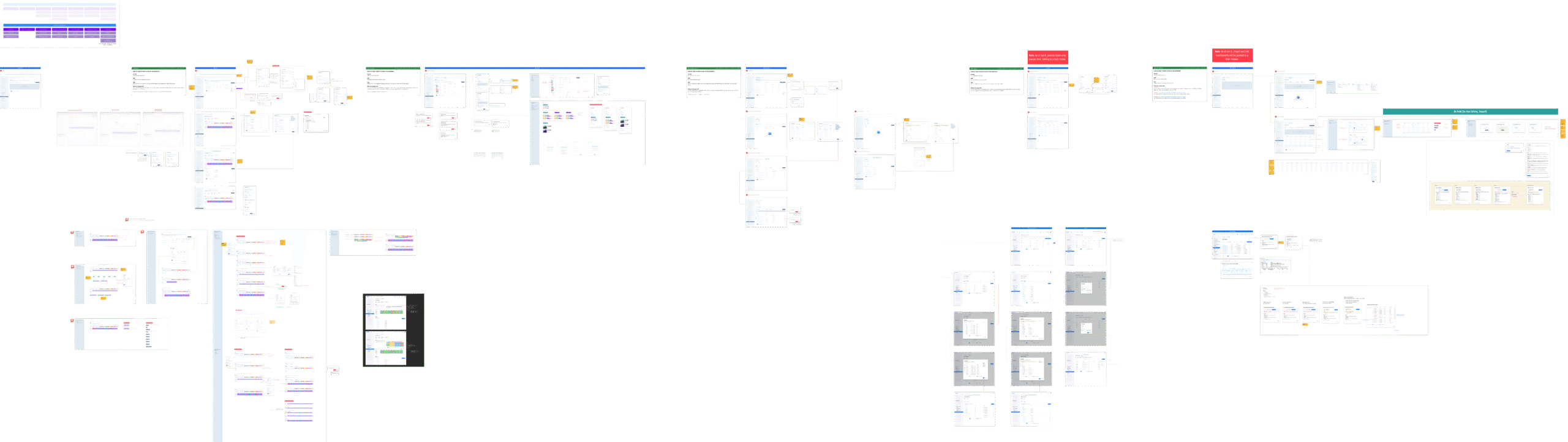
I established integrated design-engineering workflows that facilitated incremental feature delivery and continuous iteration. Our internal support team became an essential testing resource, providing authentic real-world feedback informed by their deep knowledge of competitor tools. Regular customer feedback sessions throughout the development cycle enabled ongoing design refinement, ensuring our final solution genuinely addressed user needs and market gaps.
LAUNCH STRATEGY
A phased launch approach that began with an early Beta release to a carefully selected group of customers, enabling us to validate core functionality in real-world environments. Working closely with support and sales teams, I established structured feedback loops that captured user insights and identified optimization opportunities before broader market release. This strategic approach allowed us to refine the product based on authentic user behavior and business impact, ultimately enabling our transition to General Availability ahead of the original timeline—representing a significant company milestone and demonstrating the effectiveness of our user-centered design process.
IMPACT
-
Successfully launched two new products from 0→1 in under 10 months, establishing market presence in competitive WFM/QM space
- Achieved internal adoption across contact center operations, eliminating costly third-party tool dependencies
- Secured executive support through strong Beta program results and early customer wins that generated new revenue streams
- Pioneered scrum methodology adoption, improving delivery velocity and influencing broader organizational process transformation
LEARNINGS
- Flexibility is critical. Continuously adapted priorities based on real-time feedback while maintaining focus on core user value
- Speed doesn’t compromise quality with tight processes. Close team alignment and rapid feedback loops enabled high-velocity decision-making without sacrificing user experience
- Start small, scale strategically. Early focus on core Jobs-To-Be-Done delivered meaningful outcomes within constraints, then expanded based on validated success
- Cross-functional collaboration amplifies impact. Close partnership with product, engineering, and go-to-market teams accelerated both development and adoption